After a long day of sharing at the IT Roundtable about everything from WiFi to training and volunteers, we took a break around 4:30 pm and began a lot of conversations in groups of 2 to 5 people. The reps from Shelby, ACS, and Fellowship Tech joined in those conversations. That went on for a couple of hours until the long-awaited Church Management System (ChMS) discussion began. We were just warming up when the pizza arrived courtesy of Shelby and suddenly food seemed more important than ChMS (imagine that!). After pizza we toured the facility and had more conversation in small groups. I think I was one of the last to leave at 10:00 pm. So we started the conversation (or more accurately we continued the conversation that has already begun in the blogosphere and on Tony’s Google group), but we didn’t finish it. Reflecting on that, I realized we will never finish it. So here is another installment in the conversation …
To open the discussion I put up the question: “What do we need the system to do?” This is the usual starting place because we typically think system selection is mostly a matter of determining which system’s features have the best match with our needs. Everyone around the table, with the notable exception of Terry Chapman, agreed with my assertion that no available system perfectly meets our needs today. (Terry is the CIO at Fellowship Church, so Fellowship One is a hand-in-glove fit for them.) John Dolan then rephrased my question as: “Which system stinks the least?” And Tony Dye focused in on the “we” in my original question. “Who is ‘we’?” he asked.
Exactly. Depending on who “we” are, a given system might meet our needs. But unless we built it ourselves, as Fellowship Church did, we’re probably stuck forever with the question, “Which system stinks the least?” (And by the way, Terry said he doesn’t recommend building your own ChMS.) So we start with the assumption that, at a high level, the first issue is “build it or buy it?” And most of us get to “buy it” pretty quickly, perhaps without even consciously considering “build it,” because that option is simply not feasible for most of us.
I then wondered out loud whether “What do we need the system to do?” is the right question with which to begin. I would like to ask what I think is a pre-requisite question. In fact, my question challenges the assumption that our top-level options are build it or buy it. My question challenges the assumption that we have to choose a commercial or open source system and run with it. My question is, “What kind of structure do we need in the ChMS market?” Or, “What kind of business model would optimize the relationships among churches and ChMS suppliers?” Or, “Why should I have to choose whether to run Shelby, ACS, or Fellowship exclusive of the others?” Either/or choices might be our only choices today, but can we imagine a marketplace in which both/and is a possibility? That would radically alter the risk calculation and make my job as IT Director much easier. What technical and non-technical principles would need to be in place for such a world to come into existence?
Ruminate on that a bit while I compose my next post. And feel free to comment. ;-)
September 21, 2006


IT Roundtable at Granger
What an awesome experience it was to be at Granger Community Church with a bunch of other “church nerds” talking about church IT! My only complaint is that our time together was too short. It was great to meet so many of you in person after reading your blogs, and great to renew acquaintances with old friends.
A big “thank you” to Jason for organizing the event and hosting us. Granger is a place where God is doing remarkable things. It was inspiring just being in their facility and interacting with their people.
We definitely need to do it again some time.
A big “thank you” to Jason for organizing the event and hosting us. Granger is a place where God is doing remarkable things. It was inspiring just being in their facility and interacting with their people.
We definitely need to do it again some time.
September 13, 2006
To block or not to block?
We're blocking both MySpace and Facebook at our firewall. Our youth pastor and his boss decided to do this because the school districts are doing it. Their argument is: Why should we be less restrictive than the schools? I'm conflicted about it.
Do you have web content filtration in your network? If so, do you block social networking sites? What are the pluses and minues?
By the way, Scoble says MySpace is for kids; Facebook is for adults. Makes sense.
Do you have web content filtration in your network? If so, do you block social networking sites? What are the pluses and minues?
By the way, Scoble says MySpace is for kids; Facebook is for adults. Makes sense.
September 11, 2006
Comparing a podcast to "teleportation" in Acts 8
This morning Mark Batterson posted about how after leading the Ethiopian Eunuch to Christ, Philip "teleported" to Azotus (actually the text says "the eunuch did not see him again ... Philip, however, appeared at Azotus ..."). Mark compared this to his ability to "teleport" all over the world via podcast. Those of us who are church IT nerds and not pastors really need people like Mark Batterson to put what we do in theological terms. Thanks, Mark. Hopefully I'll remember this the next time someone asks me about church podcasting.
August 27, 2006
Tony Morgan asks a great question
Check out Tony Morgan's post today "Lifting people up or loading people down?" Tony, it's not only volunteers we need to be concerned about. Sometimes it's staff.
This issue of work/rest balance in life is resonating with me, particularly in light of the talks by Andy Stanley and Wayne Cordeiro (thanks Tony for the synopsis) at the Willow Creek Leadership Summit. I attended the Summit with my whole team, several of whom said Andy and Wayne were talking to me. I needed to slow down, they said. So the next week I took a day off and moved my daughter into her dorm for her freshman year at Park University. That was important, but I have some more resting to do.
It's been a difficult summer:
So Tony, I'm with you. As one of the burdened, I'm wondering if sometimes we're adding to the burdens of our congregants, volunteers, and staff. If they've had a summer anything like mine, they're ready for some rest. Yet others are ready to take the next step if only we will challenge them. We need wisdom to know when to push and when to relax.
This issue of work/rest balance in life is resonating with me, particularly in light of the talks by Andy Stanley and Wayne Cordeiro (thanks Tony for the synopsis) at the Willow Creek Leadership Summit. I attended the Summit with my whole team, several of whom said Andy and Wayne were talking to me. I needed to slow down, they said. So the next week I took a day off and moved my daughter into her dorm for her freshman year at Park University. That was important, but I have some more resting to do.
It's been a difficult summer:
- We lost a staff person in IT - the 3rd one we've lost this year (and it really hurt)
- We had the usual vacations
- I had the most unfortunate experience of passing a kidney stone
- We hosted the Willow Creek conference
- We've had emergency outages in our phone service and our database server (which hosts Shelby and Track It)
- We've had a number of major infrastructure projects going on including new firewall, new web content filtration system, new anti-virus software, new phone company, new online bookstore, new online box office, updated web site navigation, and the biggest of all, our new location - Resurrection West
- And all of this is on top of our routine workload of tech support, computer upgrades, new staff coming in, and on and on
So Tony, I'm with you. As one of the burdened, I'm wondering if sometimes we're adding to the burdens of our congregants, volunteers, and staff. If they've had a summer anything like mine, they're ready for some rest. Yet others are ready to take the next step if only we will challenge them. We need wisdom to know when to push and when to relax.
August 21, 2006
Volunteering at Promise Keepers
This weekend I had the honor of serving as a volunteer Evangelism Supervisor for the Promise Keepers conference in Kansas City. Around 300 men responded to the altar call on Friday night, more than 100 of which were accepting Christ for the first time. I've done this before. It's an amazing experience every time.
I was too busy with my duties Friday night to take pictures, but here are a few shots of serving lunch to approximately 7,000 men on Saturday.

And here they come! (By the way, I saw Jim Walton in this line. I hope you had a great experience, Jim.)
I was too busy with my duties Friday night to take pictures, but here are a few shots of serving lunch to approximately 7,000 men on Saturday.
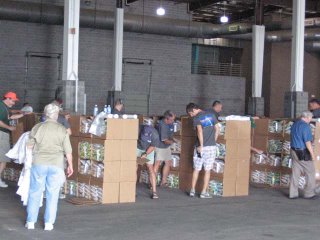
Promise Keepers has been serving lunch at the conference for years. They have it down to a science. A refigerated semi-truck rolled in, a forklift unloaded pallets of boxes, volunteers stacked them just a certain way, and finally the volunteers opened the boxes.
Each box has eleven lunches. They're all the same so people won't take time looking for their preference.
And here they come! (By the way, I saw Jim Walton in this line. I hope you had a great experience, Jim.)
August 20, 2006
Blastoff
 Resurrection West Blasted off today. And I do mean blasted. More than 700 people were in attendance at the LAUNCH of what is essentially a new church. Thats gotta be some kind of record. I think of today as the Wedding, now comes the marriage....

The venue is a Junior High School about 10 miles from the central (original) campus. We use a high definition feed from the central campus (ask cliff if you want to understand all the technology...I just think its cool). Above Left Adam interviews some folks who restore classic cars, and over on the right pastor Molly Simpson gives announcements in front of the HD screen.
August 11, 2006
Leadership Summit
This is the first time we've hosted the Willow Creek Leadership Summit at Church of the Resurrection. Ian helped me setup a laptop to connect to the Windows Media video stream for use as a backup to the main video feed that comes in over satellite. Turns out, we needed it in the very first session on Thursday morning due to storms in both Chicago and Kansas City. Good thing it worked!
Here's the rigged-up rear-screen projector:

Here's the rigged-up rear-screen projector:
This is the laptop showing the video stream full-screen:
Conference attendees in the sanctuary:
People in the Narthex:
My wife, Laura, and daughter, Beth:
July 27, 2006
July 23, 2006
Reflections on the TYPO3 Conference
I previously posted about the TYPO3 Conference, but wanted to expand on it a bit. Thinking back on the event re-affirms my excitement to be a part of the Web Empowered Church ministry. This was the second conference, and the second opportunity I had to meet Kasper Skårhøj, the creator of the TYPO3 CMF. Kasper is a character, and a great individual with a strong passion for quality and perfection.
This year, Kasper was in good spirit from becoming a new dad just a few months earlier, but was also excited to renew his connection with WEC. In the past, Kasper expressed how he struggled with the motivation to continue maintaining TYPO3, as it was not a perfect fit for his desires as it was earlier in time. At this years conference, he expressed how deeply connected he now felt to the WEC ministry, and how he wished to contribute more than was able. When he released TYPO3 in the open source world his vision was brining it to the church world, enabling them to perform ministry on the web with ease and ability. It seems WEC has been formed to help push the ball over that goal line. His motivation was renewed with TYPO3 being brought to the church like he initially envisioned.
At the same time, those of us performing WEC tasks have become much more knowledgeable in TYPO3, not leaning so heavily on the TYPO3 community to make progress, and we are giving back to the community more. The WEC ministry is now in full swing, more capable than ever, and more supported than I ever imagined by Kaspers personal commitment who believes it a God match.
So coming back to my reflections, I am excited to be a part of WEC for all of these reasons. God brought me to Church of the Resurrection five years ago for some purpose, and although I don't feel worthy, I believe it was to do my part to bring WEC & TYPO3 to churches. It is exciting to be a team mate with these individuals, and partner with those supporting WEC. I'm looking forward to what the future will bring and where God will lead us.
July 17, 2006
Blackbaud's open API
In a post last week, Tony Dye quoted Blackbaud's CTO regarding their open API. I hope other ChMS vendors are reading Tony's blog and took note of that post.
I'm done with Pluck
I'm done with Pluck.
Last summer when I began blogging and reading blogs on a regular basis, I surveyed the available RSS readers and ended up liking and using Pluck. I liked Pluck because it integrates with IE and it allows me to mark posts as read so at any time I can come back and see easily the unread posts.
Unfortnately, Pluck has been neglected. It hasn't been updated since last November and now certain bugs are really starting to bug me. Recently I realized that Pluck was missing new posts in some of my favorite blogs. It also frequently has errors reading feeds, which show up as messages I have to mark as read.
I tried Bloglines, which is cool, but it won't import my OPML and I don't have the patience to re-subscribe to all of my feeds in Bloglines.
I'm playing around with Vista beta 2 and Office 2007 beta 2. Vista comes with IE 7 with its built-in RSS reader. So that's my new reader, at least for now. Goodbye Pluck, I'm sorry to leave but you let me down.
July 02, 2006
United Methodist Worship, North Carolina Style
This past Sunday morning the Web Empowered Church team attended two churches to give our guest, Kasper, a taste of different worship services here in North Carolina, US. First we attended the Long's Chapel UMC worship service. This was a modern church building which extended off an original stone building. The sanctuary felt new, with pews on an angled floor, and a beautiful wooden roof having a look of yellow pine. The roof was flat, and angled upward from the corners of the room up to a square center, which raised up to let light in through small windows at the top. It reminded my wife and I of a Catholic sanctuary we visited last year while we were in Wisconsin. Both created a beautiful vertical space that gave a very personal feel to the room, and left you with a sense of awe.
The service was contemporary, with songs that were thoroughly approved by my wife, and we had the pleasure of witnessing a baptism. Everything had a touch of Southern style to it, which is hard to describe here in words other than "a comfort of home." This was the weekend before Independence Day, so the theme was patriotic, along with the sermon. The pastor spoke about church and politics, Chucks favorite topics I might add, and mentioned Jesus' response to paying taxes, "Give to Caesar what is Caesars, and give to God what is Gods." The message, as it should be - simple, hold God above all things in your heart.
The second service we attended was at the Stuart Auditorium at Lake Junaluska, through the South Eastern Jurisdiction. The auditorium was an open gathering hall, originally constructed with a tin roof and sawdust floor. The building we were in now was more modern than that, but still considered strange, with a very high wood roof and this large white structure coming out of the middle, descending down into the center from the ceiling. The only way to describe this thing was it looked it like it could sprout legs and walk off like a some version of the mechanical beast from the movie, Wild, Wild West. The sides of the building were very open, with fans hanging down to cool the inside temperature.
Other than the distraction of analysing the strange structure, I thought the service had a well seasoned choir, and the speaker of the week was William Willimon. He did use some "churchy" words in the sermon, and lightly dusted the sermon with dry humor about the disagreements between liberal and conservative churches regarding whether the Christian church needed a full body resurrection to believe in Christ. It was delivered in good taste, with no names mentioned.
It was wonderful to be able to experience not one but two Sunday services, both of which my wife attended and survived to my surprise, and something I'll be able to remember quite a while.
June 30, 2006
Conference - TYPO3
I've been here in North Carolina at The Foundation for Evangelism at Lake Junaluska over this week, learning more of the TYPO3 CMF. This in relation to the Web Empowered Church ministry. It has been the second opportunity I've had to meet and be inspired by Kasper Skårhøj, the creator of TYPO3, and although we drove quite deep into the technical, what stood out the most was Kasper's expression of his original mission with TYPO3. He always saw TYPO3 as a tool for ministry, which is now being realized with Web Empowered Church.
I try to step outside of myself and realize how truly unique it is for Christianity and technology to come together in such a way. The room is filled with twenty people who have come to have Kasper impart knowledge about TYPO3, but all have come to imagine new ways that expand the Lord's Kingdom through Internet Ministry utilizing TYPO3. We have people representing Web Empowered Church, freelance consultants, church staff, and ISPs. In short, Christian technology geeks, a categorization I happily place myself in. :p
I began as a WEC developer in January 2006, coming on board for multiple reasons. The short list being empowering the local church with tools for ministry, the fact that WEC is a global ministry with the ability to affect people on that scale, and most importantly because I felt God calling me to do this, which tells me all I need to know about WEC. Also, as Kasper expresses in his corner of the web, what better way to honor God than using the ability he gave me?
I rather enjoyed visiting The Foundation For Evangelism and experiencing their culture here at Lake Junaluska. It is the first time I've visited this part of the South, and I have to say you can hear all you can of southern hospitality, but until you experience it - you won't get it, trust me. The Foundation staff were extraordinary.
Although I came away with a deeper technical knowledge that will empower my ability in this ministry, I also came away with an experience being another notch on the pole of my spiritual growth. As some in the community would say, +1.
June 27, 2006
Podcasting sermons
Dan Bryant, a Disciple pastor in Eugene, Oregon, recently e-mailed a question about the Living Water site. Rather than answer him individually, I am posting the answer here. Dan writes:
Dan, start with my post explaining the simple technology behind how we publish the Living Water podcast on the web. Next, take a look at the post where I talk about the process of getting listed in the iTunes Music Store podcast directory.
Now, all of the above assumes you can create MP3 files of your sermons. At Living Water I do that by recording the service live off the house mixer, through a DBX 166 compressor, and then to a Tascam CD recorder. After the service, I use FreeRip to rip the sermon track to WAV. Then I use my 5 year-old copy of Cool Edit 2000 to trim it, adjust levels, and save it out as an MP3. Finally, I use MP3tag to fill in the metadata for the MP3 file. Yes, that is quite a few steps. None of the steps are particularly difficult, but it's a lot of fiddling around.
Looking for a simpler way? Try Sermons Online. I haven't used it, but my fellow Appian Way blogger, Chuck Russell, highly recommends it.
As to whether it is useful, we are excited that we have many people across the country and around the world downloading our sermon podcast. In fact, our weekly podcast downloads exceed our average worship attendance. A statistic like that will really make you take notice.
Thanks for the question, Brian. And happy podcasting!
I am exploring podcasting and found yours. Nicely done! Can you tell me a little about your experience with it, how much effort it takes, how useful it is, software you use, etc.?
Dan, start with my post explaining the simple technology behind how we publish the Living Water podcast on the web. Next, take a look at the post where I talk about the process of getting listed in the iTunes Music Store podcast directory.
Now, all of the above assumes you can create MP3 files of your sermons. At Living Water I do that by recording the service live off the house mixer, through a DBX 166 compressor, and then to a Tascam CD recorder. After the service, I use FreeRip to rip the sermon track to WAV. Then I use my 5 year-old copy of Cool Edit 2000 to trim it, adjust levels, and save it out as an MP3. Finally, I use MP3tag to fill in the metadata for the MP3 file. Yes, that is quite a few steps. None of the steps are particularly difficult, but it's a lot of fiddling around.
Looking for a simpler way? Try Sermons Online. I haven't used it, but my fellow Appian Way blogger, Chuck Russell, highly recommends it.
As to whether it is useful, we are excited that we have many people across the country and around the world downloading our sermon podcast. In fact, our weekly podcast downloads exceed our average worship attendance. A statistic like that will really make you take notice.
Thanks for the question, Brian. And happy podcasting!
Meeting Kasper in North Carolina
Brian and I are in Lake Junaluska, North Carolina (in the Smoky Mountains of western North Carolina) for a meeting of Web Empowered Church developers. Tonight I got to meet Kasper Skarhoj, the original brain behind TYPO3. I wished for a camera so I could show you Brian, Pania (Brian's wife), me, Mark Stephenson, Kasper, Mark's son, and Jeff Segars at dinner tonight. It was a historic moment.
Brian and I will have more to say about the conference over the next couple of days.
Brian and I will have more to say about the conference over the next couple of days.
June 08, 2006
Open source Church Management System (ChMS)
Shelley Hildebrand of Perimeter Church recently posted to the Church Management System (ChMS) Google group to ask whether there is interest among churches in building an open source church management system. Then she e-mailed me and asked if I would post a reply. This is a huge question that I have been pondering for most of three years. I can't possibly give a full explanation of our current thinking in a single post, but here at least is a strategic summary.
>>First, many readers of this blog and the Google discussion group already know about Web Empowered Church (WEC), but for those who don't ...
WEC is an initiative of the Methodist Foundation for Evangelism. The director of WEC is Mark Stephenson, Director of Cyber Ministry for Ginghamsburg Church, a large and well-known Methodist church outside Dayton, Ohio. WEC is building church-specific web applications on top of an enterprise-class, open source content management system called TYPO3.
TYPO3 is very powerful and so not surprisingly it's quite complex as well. Consequently it has a fairly steep learning curve, even for experienced web developers. To help new churches get over this complexity barrier, WEC provides a pre-configured TYPO3 package called the "WEC Starter Package," with all of the WEC-built ministry extensions pre-loaded. WEC has some pre-built TYPO3 templates to accelerate site design for smaller churches that don't want to do a custom design. Also, WEC has established a web hosting firm in the greater Philadelphia area called Vine Hosting. Their equipment is located in a world-class data center in Newark, New Jersey. Through the Starter Package, the pre-built templates, and the hosting, WEC is working diligently over time to ease the difficulty of building and running a church web site in TYPO3.
WEC has been operating less than two years and has already gotten some serious worldwide traction. See the cool Google mashup map of churches around the world using WEC and a list of example sites.
I am the IT Director at Church of the Resurrection in Leawood, Kansas (Kansas City area). We were the first church to catch Mark's vision for WEC and become part of it. We rebuilt our sites in TYPO3 starting in July 2004 and went live five months later. Earlier this year, we forged an even deeper connection with WEC when our most senior IT guy, Brian Slezak, transitioned into a new role as a software developer with WEC. He is still on our staff and still has a desk in our department, but he now works full-time on building ministry extensions for WEC.
Bottom line: WEC has all the earmarks of a God thing. It's a God-sized dream being lived out in a Kingdom-like way. It's amazing what God has already done and very exciting to see what God will continue to do in the future through WEC.
>>Okay, so what does all of this have to do with the question of an open source church management system? I realize that open source isn't for everyone. At Resurrection we are a Microsoft shop everywhere except our web sites. I'm not a Microsoft basher at all. We use a lot of their stuff and are particularly appreciative of their steep non-profit discounts. Also, I can see a place for commercial providers of church management systems such as Shelby, ACS, and Fellowship Tech. I know some people with these companies are readers of this blog and our Google discussion group. I don't speak for Resurrection, but I know that the church values its suppliers and seeks to bless those who provide us with everything we need to do ministry.
Having said that, I do believe that God is honored and the Kingdom is advanced when churches across geographical and denominational boundaries come together in the common cause of disciple making. We have differing styles, mission fields, and theological points of view, but we have one Lord and we proclaim one gospel. We're all on the same team. Take a good look at that WEC map and you'll see an amazing example of how this vision of cooperation is actually working in the world right now. Thinking strategically about this, I conclude that the open source model of software development and distribution is ideally suited to fostering technological cooperation among churches around the world. Let me quickly add that I acknowledge the technical challenges of open source, including the lack of support for "normal people" mentioned by Jeff Berg. Despite that, the benefits of open source in this situation are truly compelling. If Perimeter Church builds something on a common platform that Church of the Resurrection can pick up and use, I think we really have something special going on that glorifies God and represents awesome stewardship.
So, answering Shelley's question directly: Yes, I think open source makes total sense for the church. And yes, we are interested in working with other churches to develop an open source church management system. WEC is also very interested in this and hopes to be a catalyst and focal point for making this happen. The blogosphere is a great way to circulate this idea, gather support, and find like minded churches to get involved. I'm trying to listen to God to hear if He really is behind this. If so, within the next six months I hope to see a consensus emerge around a group of churches that will contribute resources and technology to a WEC-sponsored effort to build a ChMS on the open source/TYPO3 platform.
Is anyone else out there as excited as I am about this?
June 06, 2006
Culture of Change
I made the following comment to Tony McCollum's post about Saddleback adding services and changing service times in response to the release of The Passion of the Christ. I figured since I commented there, I should share it here too.
I was with a group of mega-church pastors (actually executive pastors) at Saddleback the week they changed all their service times. Our meeting was February 26-28, 2004. The film had opened in theaters the day before on Ash Wednesday.
As I recall (and of course it's been more than two years, so my recollection could be a bit foggy), Rick and his executive team decided only earlier that week to change service times. The movie was getting such a huge buzz, they were concerned about being overwhelmed the first weekend after the opening. So they scrambled to arrange for additional parking a few blocks away and got some shuttle buses. They opened up a new entrance onto the campus to allow for increased traffic flow. They identified the impact on everyone from Sunday School teachers, to ushers, to parking greeters and got the word out. It was an amazingly entreprenurial effort like you would see from a startup company trying to release its first product.
I'm an IT guy and I was in a breakout session with IT guys from the other mega-churches. Rick came into our session and told us that they couldn't do church the way they do it without information technology. You see, since they hadn't even announced the change to the congregation the prior weekend, the best way they had to get the word out was via e-mail.
The next week I heard from Eric Busby, Saddleback's CIO, that they had blowout attendance that weekend. Instead of a great opportunity, the surge of people would have been a disaster if they hadn't seen the wave coming and quickly adjusted to catch it. And catch it they did. People came to know Christ that weekend because of their extreme effort and willingness to change instantaneously.
Now that's a lesson in dynamic, purpose-driven, change-embracing leadership. I will remember it always.
Blogs I read
Stuart Cowen of Casting My Net asked for my list of church IT blogs that I subscribe to and read. Since I created the list for Stuart, I figured, hey, I should share it with the world. It's the next best thing to an Appian Way blogroll!
http://webevangelist.blogspot.com/
http://www.betachurch.org/
http://www.blogministry.com/
http://www.bloggingchurch.com/home/
http://brianglass.wordpress.com/
http://castingmynet.wordpress.com/
http://churchtechmatters.com/
http://www.churchnerd.com/blog/
http://www.davidblog.com/
http://www.e-vangelism.com/
http://www.eministrynotes.com/
http://godbit.com/
http://www.healyourchurchwebsite.com/
http://jpowell.blogs.com/
http://www.leaveitbehind.com/
http://rodpearcy.typepad.com/
http://www.strategicdigitaloutreach.com/
http://techshepherd.typepad.com/
http://tonydye.typepad.com/
http://guide.gospelcom.net/resources/bulletin.php
http://webempoweredchurch.org/home/
... and (of course) http://appianway.blogspot.com/ ;-)
June 03, 2006
Does the medium affect the message?
I encourage you to read this post by Shane Hipps in which he argues that electronic media isn't message-neutral. He contrasts how the text medium favors communication through systematic, linear reason, whereas the image medium favors communication through stories and experience.
Personally, I favor the use of multi-art, multimedia presentation. This approach uses emotion and reason, experience and information, story and logic to increase the liklihood of connecting in some way with each person and their different ways of learning. And yes, I agree that the medium affects the message. A multimedia approach means the communicator needs to think even more than ever about what they're saying and the most effective way to say it. I think that's a good thing.
Personally, I favor the use of multi-art, multimedia presentation. This approach uses emotion and reason, experience and information, story and logic to increase the liklihood of connecting in some way with each person and their different ways of learning. And yes, I agree that the medium affects the message. A multimedia approach means the communicator needs to think even more than ever about what they're saying and the most effective way to say it. I think that's a good thing.
Subscribe to:
Posts (Atom)
